
Phormingochilus pennellhewlettorum - The Bario Bat Eater
Phormingochilus pennellhewlettorum, known in the hobby as the Bario Bat Eater, is one of the more recently described tarantulas from Borneo - and one with a real story behind it. Long-legged, fast and impressively large, it has the elegant tree-dwelling build that makes the genus Phormingochilus so popular with keepers of Asian tarantulas.
It is an Old World arboreal species from the Kelabit Highlands of northern Sarawak, Malaysia. It is still relatively uncommon in the hobby, but captive-bred slings are turning up more regularly, and it has earned a following among keepers who already enjoy species such as Phormingochilus hatihati or Phormingochilus sp. Akcaya.
Unlike many Phormingochilus in the hobby, this one is a formally described species, so there is no "sp." label here. It was described by Andrew Smith and Michael A. Jacobi in 2015 as part of a revision of the genus, published in the Journal of the British Tarantula Society. You may occasionally see it written as "pennellhewletti", but pennellhewlettorum is the correct name.
What exactly is Phormingochilus pennellhewlettorum?
The genus Phormingochilus was described by Pocock in 1895 and belongs to the Ornithoctoninae, the group of Asian tarantulas that also includes the earth tigers. Phormingochilus species are found on Borneo and neighbouring islands, and are generally long-legged, fast, tree-dwelling spiders - which is why they are often called "tree tigers".
The species name honours Mark Pennell and Dean Hewlett, two British enthusiasts who spent years searching Sarawak for it after hearing local reports of a large tarantula in the highlands. A male turned up in 2007, the pair found the species properly in 2009, and it was confirmed as new to science and formally described in 2015.
The common name comes from Bario, the main settlement in the Kelabit Highlands, and from the spider's size and hunting ability. Don't take the "Bat Eater" part too literally - like other large tarantulas it may take a small vertebrate opportunistically in the wild, but its diet is overwhelmingly insects.
As with any rarer species, lineage matters. We always recommend buying captive-bred stock from a trusted source, which takes pressure off wild populations and gives you a spider with a known history.
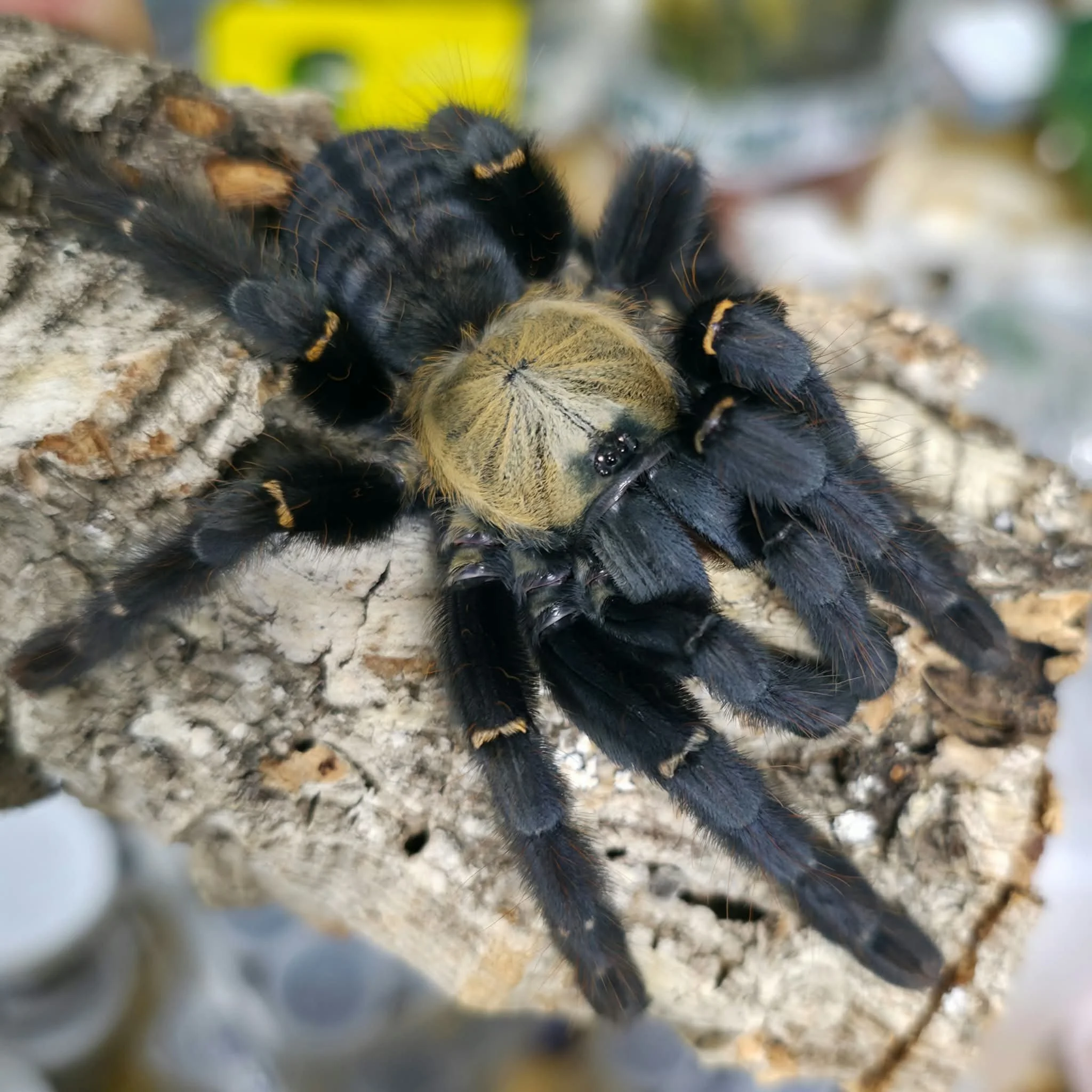
The Bario Bat Eater is a spider of subtle beauty rather than loud colour.
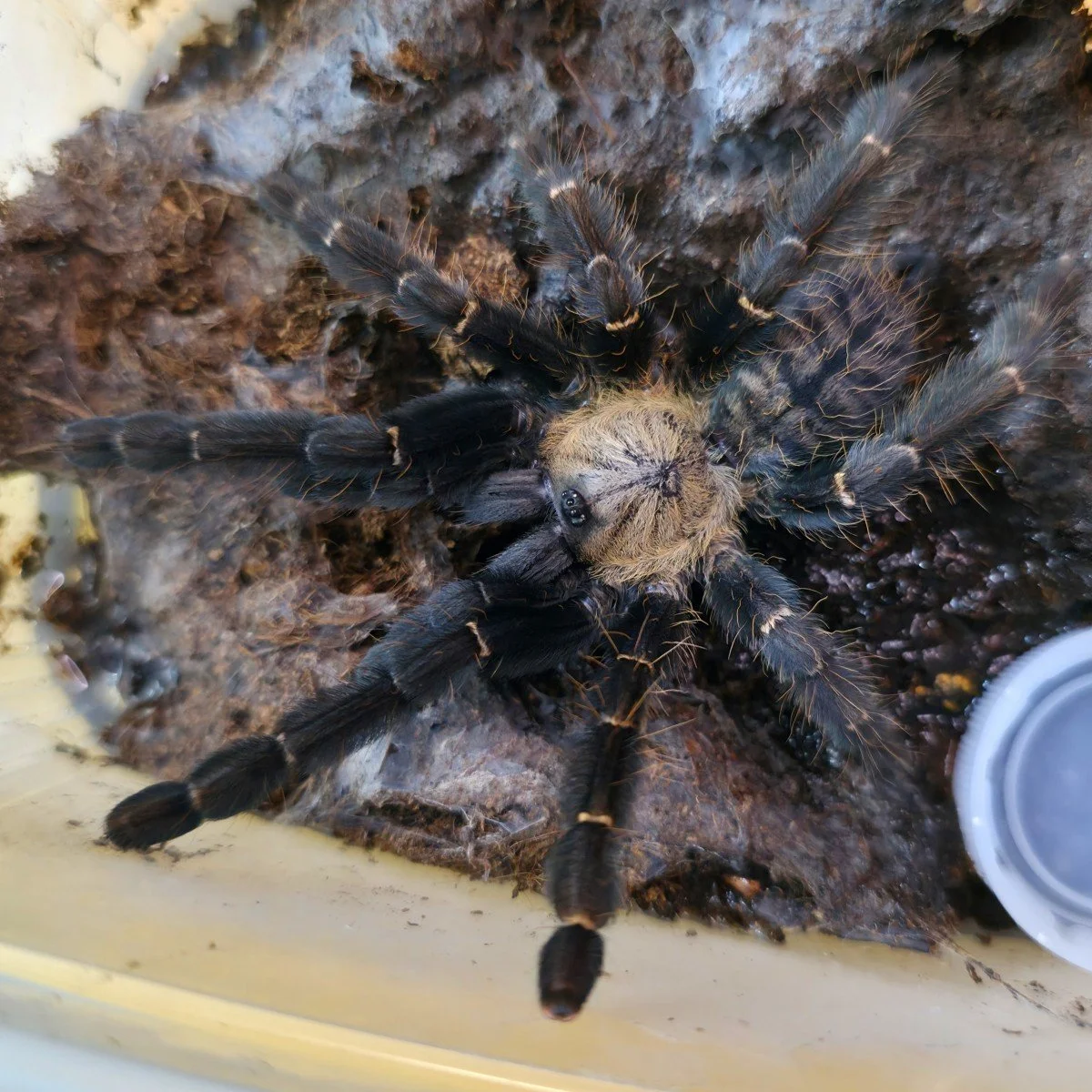
Adults are typically earthy brown to golden-bronze, covered in fine hairs that give the body a soft, velvety look and a gentle sheen in good light - a colour scheme that blends in perfectly against the bark and moss of montane rainforest trees.
As with most tarantulas, colour develops as the spider grows, and mature males are noticeably slimmer and leggier than females, as is typical for the genus.
This is a large species. Males reach around 12-13 cm (5 inches) in leg span, and females are larger still at around 15 cm (6 inches).
Where would you find Phormingochilus pennellhewlettorum?
In the wild, this species lives in the Kelabit Highlands of north-eastern Sarawak, on the island of Borneo. It is a true tree-dweller, living on and in the trunks of tall montane rainforest trees - one early specimen was famously brought down from a dipterocarp tree more than 60 feet tall by a spider-hunting wasp.
In captivity it builds thick silk tube retreats, usually behind or inside vertical cork bark. Slings and younger juveniles can behave more like burrowers at first, and it is not unusual for them to dig down and web in at substrate level before moving upwards as they grow.
Temperament is typical of a fast Asian arboreal: shy, skittish and defensive. As an Old World species it has no urticating hairs and relies on speed and its bite to defend itself, and its venom is likely to be medically significant, as with other Asian tarantulas. Expect it to bolt into its retreat when disturbed, and treat it strictly as a display animal rather than one to handle.
Phormingochilus pennellhewlettorum - the Bario Bat Eater
Phormingochilus pennellhewlettorum husbandry
Care is not complicated as long as you respect its speed and get the balance right between humidity and ventilation. It is generally regarded as a hardy, fast-growing species with a strong feeding response.
Slings can be kept in a small arboreal-style enclosure with a few centimetres of substrate - remember they may burrow at this stage - and a small piece of cork bark to web against. Upgrade once the spider reaches around a third of its adult size.
For adults, choose an arboreal enclosure that is taller than it is wide; something around 30 x 30 x 45 cm suits an adult female well. A front-opening enclosure is ideal, as it lets you feed and maintain the enclosure without tearing into a retreat built near the top.
Provide a tall piece of vertical cork bark (a hollow tube is ideal), a few plants or foliage for anchoring silk, and 8-10 cm of a moisture-retentive coco fibre or topsoil-based substrate.
Humidity and water
Coming from humid highland rainforest, this species needs more moisture than a typical terrestrial tarantula. Aim for around 70-80% humidity by keeping the substrate lightly moist and misting the enclosure walls occasionally.
Always keep a wide, full water dish available, and make sure the enclosure has good cross-ventilation - high humidity combined with stagnant air quickly leads to mould and an unhealthy spider.
Temperature
A range of around 21-28°C suits them well, so normal UK room temperatures of 22-26°C are usually fine without extra heating. A slight drop at night is natural for a highland species and nothing to worry about.
Feeding
The Bario Bat Eater is a keen eater. Slings can be fed small prey every 5-7 days, while juveniles and adults do well on a feed every 7-14 days - crickets, locusts and roaches are all good staples.
Feed prey no larger than the spider's abdomen, and remove anything uneaten after 24 hours. Before a moult it will often seal itself into its retreat; don't offer food until it has moulted and its fangs have hardened.
Is the Bario Bat Eater right for you?
Phormingochilus pennellhewlettorum offers a rare combination: a large, recently described Bornean tree spider with a genuine discovery story behind it.
It is hardy, grows quickly and eats well, and its care is very manageable for anyone who already has experience with Old World arboreal species.
The main things to bear in mind are its speed, its defensive nature and its potent venom. With no urticating hairs and a tendency to bolt, it is not a beginner species, and is best suited to keepers who are comfortable with fast Asian tarantulas.
If you want an Asian arboreal with size, presence and a bit of history, the Bario Bat Eater is well worth a place in your collection - and a fantastic next step for fans of Phormingochilus.

A stunning arboreal species from Indonesia, Phormingochilus pennellhewlettorum displays striking golden and black-blue hues with a velvety sheen. Fast-growing and display-worthy, it’s a rare gem for collectors of Asian arboreal tarantulas.
