
Ornithoctoninae sp. Phan Cay Red
Ornithoctoninae sp. "Phan Cay Red", sold in the US hobby as the Purple Blaze Tree Spider, is one of the most talked-about new Asian tarantulas of recent years. Fast, striking and still genuinely rare, it is a Vietnamese tree-dwelling tarantula that has quickly earned a following among keepers of Old World arboreals.
It only reached the hobby in the last few years, and captive-bred slings are still few and far between. If you already enjoy species such as Phormingochilus hatihati or Phormingochilus sp. Akcaya, it makes a natural next step.
It is worth saying up front that this is an undescribed spider. "Ornithoctoninae sp." simply means it belongs to the Ornithoctoninae subfamily but has not yet been formally placed in a genus or given a species name. "Phan Cay Red" is a hobby label rather than a scientific name, and you may see it listed alongside the related "Phan Cay" and "Phan Cay Blue" forms.
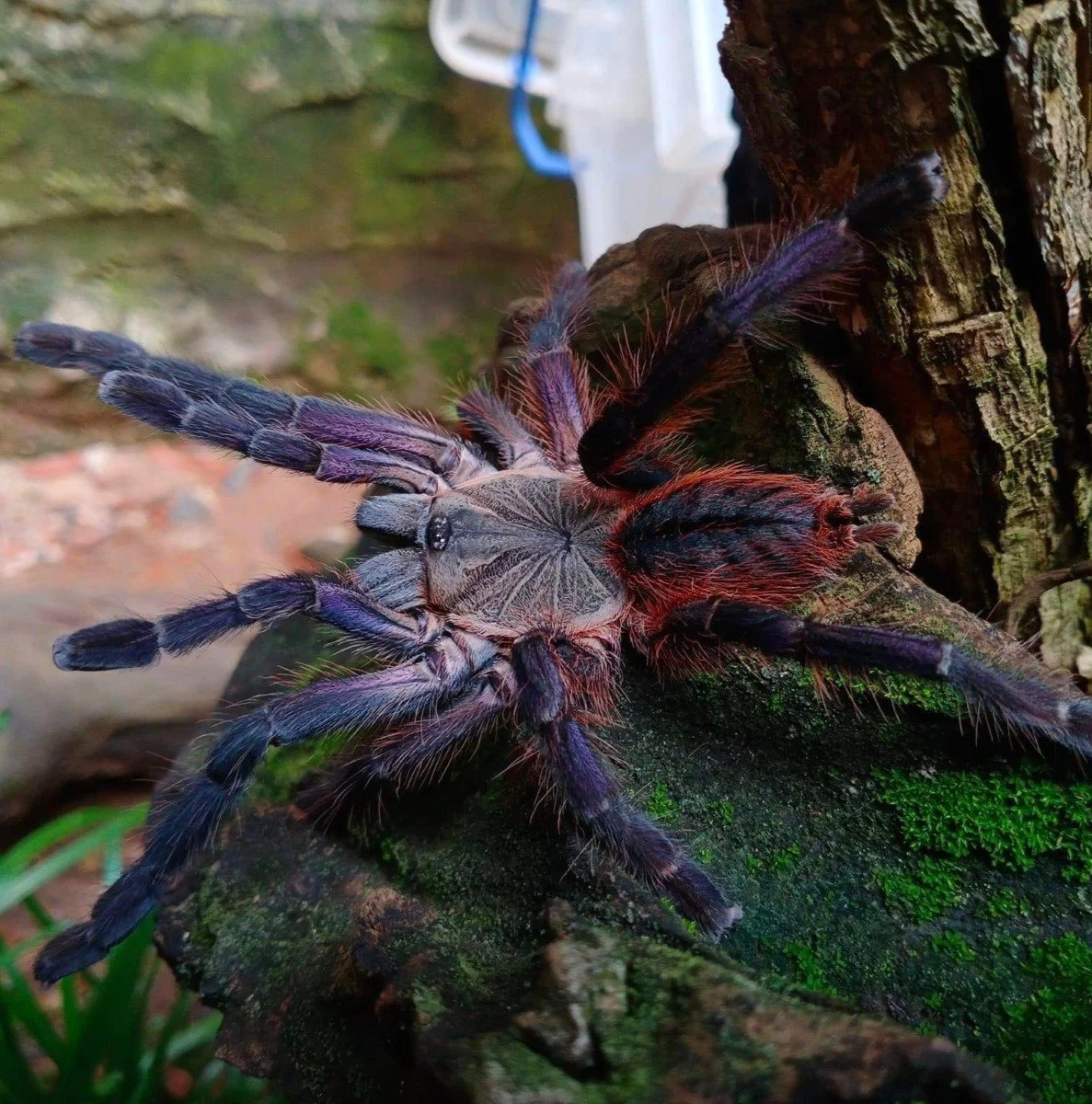
What exactly is Ornithoctoninae sp. "Phan Cay Red"?
The Ornithoctoninae are a group of Asian tarantulas that includes the earth tigers (such as Cyriopagopus and Ornithoctonus) as well as the "tree tigers" of the genus Phormingochilus. Most of the well-known earth tigers are burrowers, which is what makes the Phan Cay Red interesting - it is sold and kept as an arboreal species, much more like Phormingochilus or Omothymus in lifestyle.
Because it is undescribed, there is still a lot we don't know for certain, and different sources give slightly different figures for adult size and preferred conditions. What follows is based on keeper experience and the information available so far, and we'll update it as more animals mature in collections.
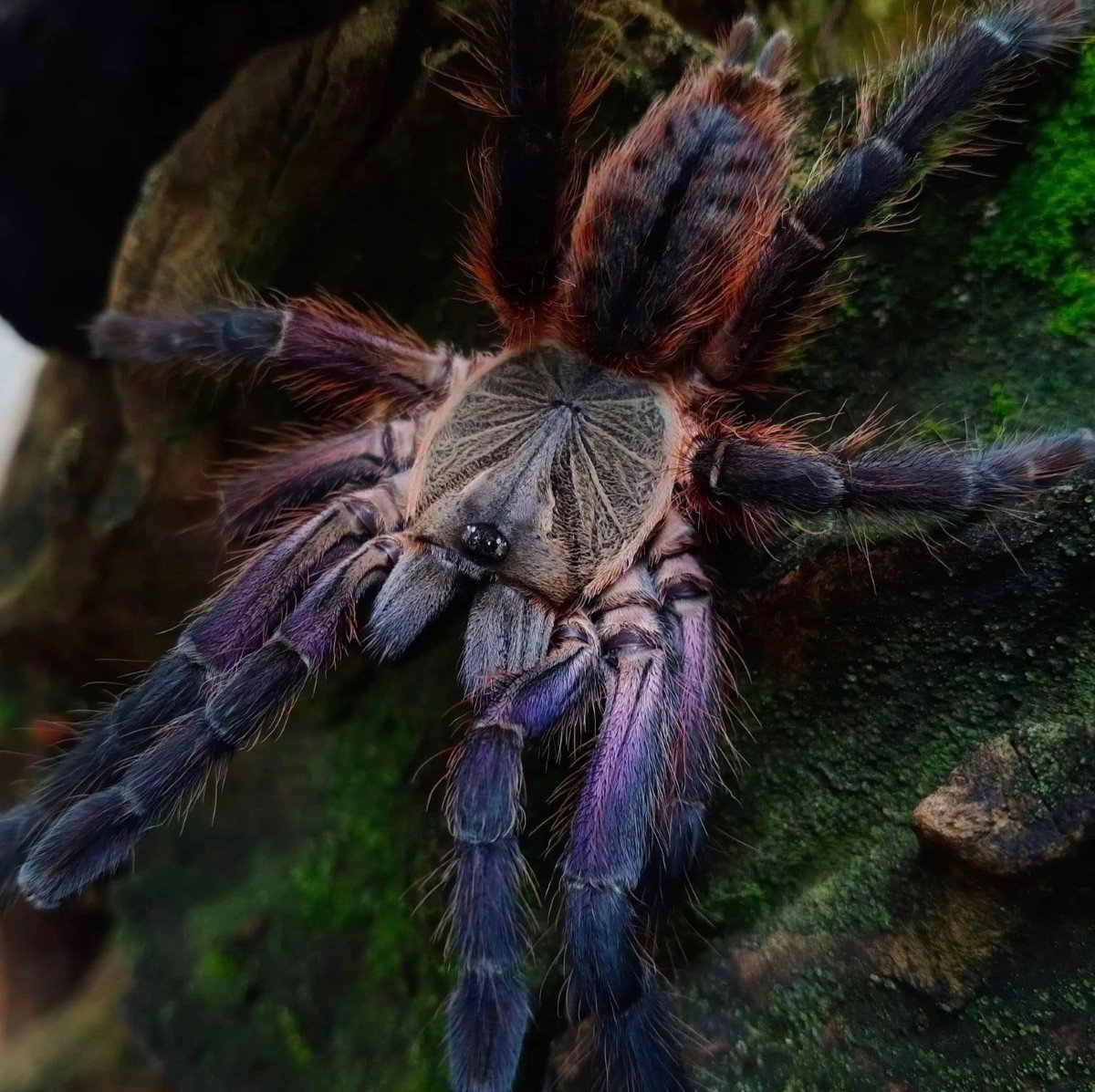
The "Red" in the name refers to the warm tones that set it apart from its sister forms, while the US trade name "Purple Blaze" comes from the violet and purple sheen that develops as it grows.
As with any rare, undescribed species, lineage matters. We always recommend buying captive-bred stock from a trusted source and keeping records of where your animals came from. With so few bloodlines in the hobby, accurate labelling - and not mixing the different "Phan Cay" forms - is important for the long-term future of this spider in captivity.
The Phan Cay Red is a spider that rewards patience when it comes to colour.
Slings and young juveniles are fairly subdued, usually tan to brown with darker patterning and subtle reddish hues. Keepers report violet iridescence appearing on the legs from around 6 cm, and some see a faint blue tint on the lower legs in natural light.
As it matures, it develops a deep, jewel-like purple sheen combined with warm red tones - the colouring behind the "Purple Blaze" name. As with most tarantulas, mature males are slimmer and leggier than females.
Adult size is still being established, but it is expected to be a medium to large species, with estimates for adult females generally around 15-18 cm (6-7 inches) in leg span.
Where would you find Ornithoctoninae sp. "Phan Cay Red"?
This form originates from Vietnam, a country that has produced a string of exciting Ornithoctoninae for the hobby in recent years. Detailed locality and habitat information has not been published, so little is known for certain about its exact wild range.
In captivity it behaves as an arboreal species, building dense silk retreats on and behind vertical cork bark. Like many Asian tree-dwellers, slings often start off behaving more like burrowers, digging small chambers and webbing in at substrate level before moving upwards as they grow.
Temperament is typical of a fast Asian tarantula: skittish and potentially defensive. Some keepers find theirs fairly calm during rehousing, but you should never count on it. As an Old World species it has no urticating hairs and relies on speed and its bite to defend itself, and its venom should be treated as medically significant. Treat it strictly as a display animal rather than one to handle.
Ornithoctoninae sp. "Phan Cay Red" - the Purple Blaze Tree Spider
Ornithoctoninae sp. "Phan Cay Red" husbandry
Care is not complicated as long as you respect its speed and get the balance right between humidity and ventilation. It is generally a keen eater with a steady growth rate.
Slings can be kept in a small, well-ventilated container with a few centimetres of moisture-retentive substrate - remember they will often burrow at this stage - and a small piece of cork bark to web against. Upgrade once the spider is climbing and has reached roughly a third of its adult size.
For adults, choose an arboreal enclosure that is taller than it is wide; something around 30 x 30 x 45 cm suits an adult female well. A front-opening enclosure is ideal, as it lets you feed and maintain the enclosure without tearing into a retreat built near the top.
Provide a tall piece of vertical cork bark (a hollow tube is ideal), some plants or foliage for anchoring silk, and 8-10 cm of coco fibre or a topsoil-based substrate.
Humidity and water
This tropical species appreciates moderate to high humidity. Aim for roughly 70-80% by keeping the lower layers of substrate lightly moist while letting the surface dry a little between waterings, and mist the enclosure walls occasionally.
Always keep a water dish available - an elevated dish, or one placed near the cork bark, works well for an arboreal species. Good cross-ventilation is essential: high humidity combined with stagnant air quickly leads to mould and an unhealthy spider.
Temperature
A range of around 22-27°C suits them well, so normal UK room temperatures are usually fine, with a little extra warmth in the colder months if your room drops low. Some keepers keep females slightly warmer to encourage growth.
Feeding
The Phan Cay Red has a strong feeding response. Slings can be fed small prey every 5-7 days, while juveniles and adults do well on a feed every 7-14 days - crickets, locusts and roaches are all good staples.
Feed prey no larger than the spider's abdomen, and remove anything uneaten after 24 hours. Before a moult it will often seal itself into its retreat, and premoult can be lengthy - don't offer food until it has moulted and its fangs have hardened.
Is the Phan Cay Red right for you?
Ornithoctoninae sp. "Phan Cay Red" offers something special: a rare, newly arrived Vietnamese tree spider with striking purple-and-red colour that develops as it grows.
It eats well, and its care is very manageable for anyone who already has experience with Old World arboreal species.
The main things to bear in mind are its speed, its potentially defensive nature and its potent venom. With no urticating hairs and a tendency to bolt, it is not a beginner species, and is best suited to keepers who are comfortable with fast Asian tarantulas.
If you want an Asian arboreal that is still a genuine rarity in the UK hobby, the Phan Cay Red is well worth a place in your collection - and a fantastic choice for fans of Phormingochilus and the earth tigers.
Ornithoctoninae sp. Phan Cay Red: A striking Old World arboreal/fossorial tarantula native to Vietnam, famed for its deep purple-violet legs, red abdominal setae, and dark carapace. This lightning-fast, highly defensive species is strictly for the experienced keeper. A aggressive, heavy-webbing tarantula. Spiderlings are CB true line from the original first specimens that were brought to Europe a few years ago.
