
How to Care for a Tarantula: Simple Setup & Feeding Guide
Introduction
Caring for a tarantula might seem intimidating at first, but once you understand the basics and more importantly the needs of the species you are caring for then they become relatively low maintenance pets. One of the most important things for beginners to realise is that tarantula care isn’t the exact same for all tarantulas. Different species have slightly different needs, and their natural lifestyles play a huge role in how you should set up their enclosure and care routine. Tarantulas fall into three main categories, Terrestrial, meaning ground dwelling; Arboreal, tree dwelling; and Fossorial, meaning burrowing.
In this guide, we’ll break down the basic steps you should take to care for Tarantulas. From choosing the right enclosure and setting it up correctly to feeding your tarantula and maintaining the ideal heat and humidity. Whether you’re looking to purchase your very first spider or just want to improve your care routine, this guide will give you the confidence to do it right.
Setup
All tarantulas require:
Good quality substrate.
A place to hide (cork bark).
Water bowl
However, there a few differences you need to consider when setting up your enclosures for your chosen species.
Terrestrial species typically prefer wider enclosures with plenty of floor space, typically you will want to choose an enclosure that is as wide as it is tall. You can add plants and other decor if you’d like.
Examples of terrestrial spiders include, Grammostola Rosea and Brachypelma Auratum
Arboreal species will need height and things to climb on so you will require an enclosure that is taller rather than wider. We would advise adding plants to make your enclosure as close to nature as possible.
Examples of arboreal species include, Psalmopoeus Irminia and Avicularia Avicularia.
Fossorial species require deep substrate to dig and create underground tunnels. You will want to chose an enclosure that is tall so you can fill it with substrate. We would advise adding plants and natural matter to make your enclosure as close to nature as possible.
Examples of fossorial species include, Chilobrachys Natanicharum
You can shop our range of acrylic tarantula enclosures here.
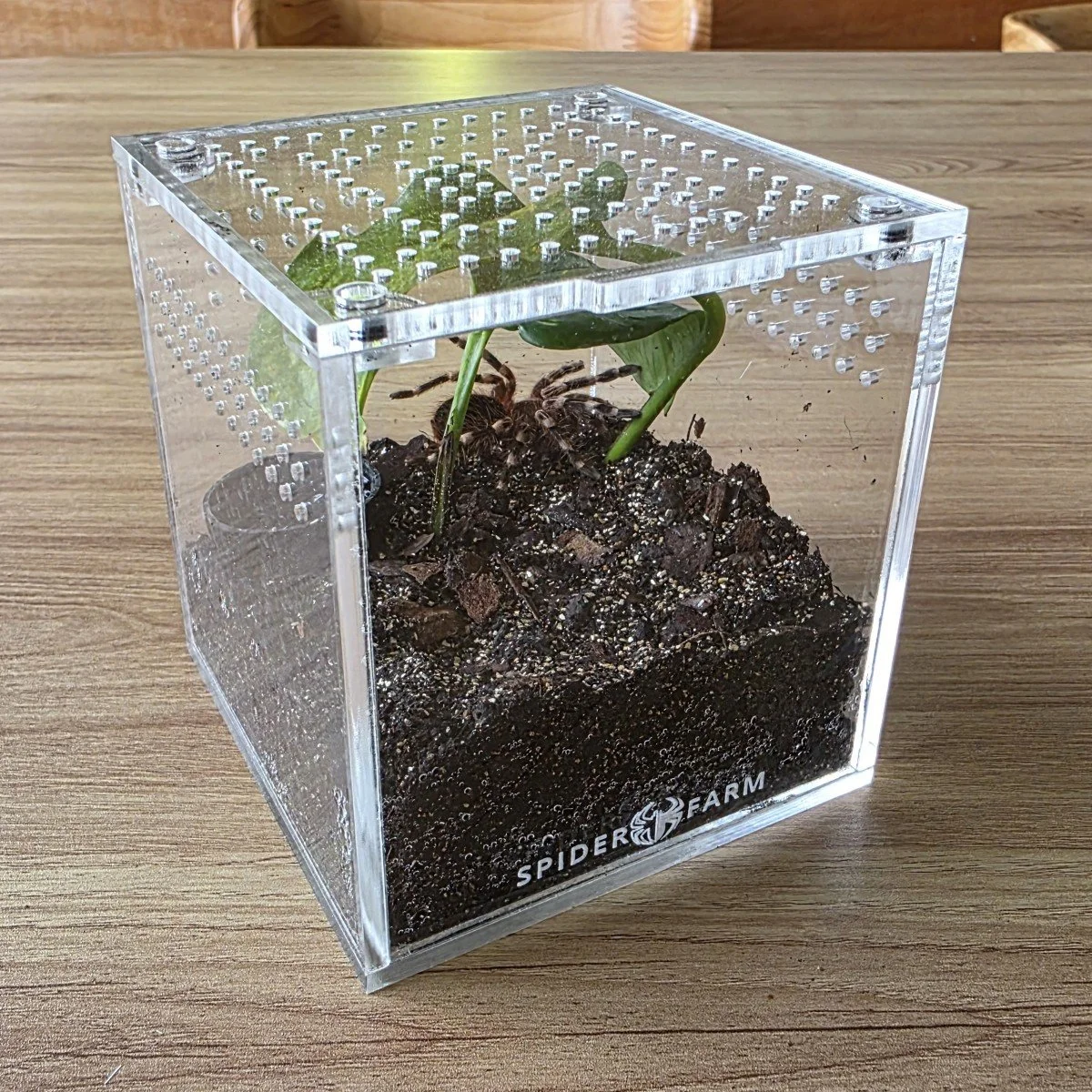
SPIDER FARM premium acrylic Cube enclosure is perfect for grown-on slings and juvenile tarantulas. Measuring 10 cm wide, 10 cm deep, and 10 cm high, it offers excellent visibility and ventilation for a healthy environment. Made from premium-quality SPIDER FARM acrylic. Substrate and décor sold separately.
Heating & Humidity
Many tarantulas come from warm climates and need to be heated, as well as this you need to ensure your humidity levels are as close to their natural climate as possible. To find the exact temperatures and humidity levels for your tarantula, you should research your chosen species.
There are many ways to heat your spider, the most practical way is through the use of a heat mat. If you are using a heat mat, ensure that the heat mat is not placed directly under the enclosure, but instead position the heat mat to the one of the walls only. This is important as it will ensure that your enclosure has a warm spot and a cool spot.
Alternatively, you can choose to heat the entire room or area your tarantula is through the use of central heating or an oil filled heater. You should never have your spider sitting directly on a radiator or use a heat lamp/bulb to heat your enclosure.
The majority of tarantulas will be fine in a humidity range of 50-70%, however there are some species that require a higher humidity, if your chosen species does require a humidity above these levels, you can increase the humidity by spraying the enclosure with room temperature water ensuring the substrate is damp but not soaking wet.
You can use a hygrometer and thermometer to monitor the humidity and temperature in your enclosure.
Feeding
All tarantulas are predators and their diets are made up of live insects, such as mealworms, dubia roaches, crickets, locusts etc. These are all readily available in most pet shops. You should never feed wild caught insects to your tarantula(s).
You should look to feed your tarantula once per week to once a fortnight, however, it is important you do not overfeed your tarantula. As a guide the tarantulas abdomen should not be more than twice the size of the carapace. If you notice this then your spider is most likely overfed. It is common for tarantulas to go days, weeks or months without eating, so do not panic if you notice your spider is not eating as usual. Tarantulas will stop feeding whilst they are in premoult (preparing for moulting) so feeding should be avoided during this period. Tarantulas should also not be fed for a week or two after moulting as you need to allow time for their bodies and fangs to harden.
Moulting
Moulting is a natural and essential process in a tarantula’s life, allowing it to grow by shedding its old exoskeleton as it grows a new one. During this time, your tarantula may become less active and refuse food. During the moulting process your tarantula will typically lay out a web mat and flip on its back, this can be alarming at first but is completely normal.
Moulting can last anywhere from a few hours to over a day, depending on the size and species. It’s crucial not to disturb your tarantula while it moults, as any stress can cause complications. After the moult, the new exoskeleton will be soft, and the fangs need time to harden before the tarantula can safely eat again, this can take several days to a couple of weeks*, again depending on the size and species. Providing proper humidity and leaving the enclosure undisturbed are key to ensuring a successful moult and a healthy tarantula.
Slings: Wait up to 5 days before feeding
Juveniles: Wait up to 1 week before feeding
Adults: Wait 2-6 weeks before feeding
Next Steps
If you now feel confident enough to take the plunge into owning a tarantula, you should take a look at our list of best beginner species, found here. (ADD LINK HERE)
Alternatively, you can shop our vast range of tarantulas in the shop.
